The Role of X-Rays in Detecting Dental Problems
Welcome to our guide on one of the most vital tools we use to keep your smile healthy and bright. At our practice, we believe that informed patients are happy patients, and understanding the role of X-rays in dentistry is a great way to feel more confident about your care. While a visual exam tells us a lot, dental X-rays, also known as radiographs, allow us to see beyond the surface. They are essential to modern dentistry because they provide a clear “map” of your oral health, catching potential issues long before they become uncomfortable or costly to treat. Rest assured, these diagnostic tools are designed with your safety and long-term wellness in mind.
How X-Rays Detect Dental Issues
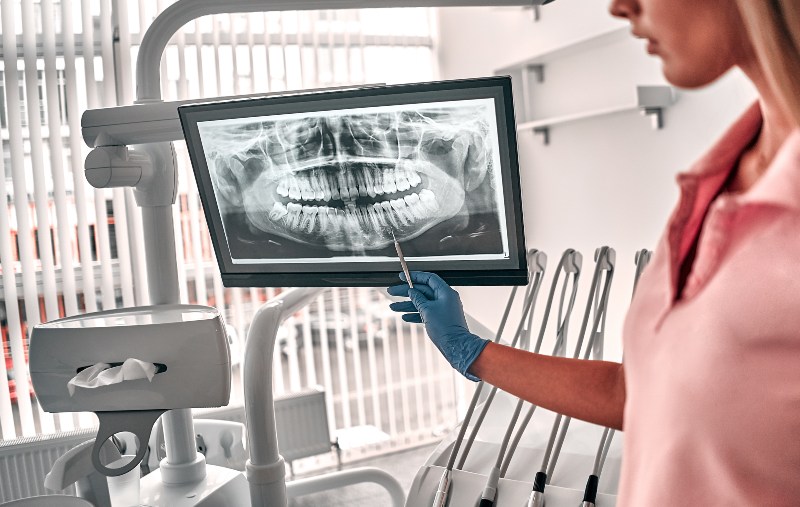
Think of an X-ray as a superpower for your dentist. While we can see your enamel and gum line during a physical checkup, many dental issues hide deep within the structure of your mouth. Dental X-rays allow us to detect:
- Hidden Decay – Cavities forming between teeth or underneath existing fillings.
- Bone Health – Bone loss associated with gum disease (periodontitis).
- Root Issues – Infections or abscesses at the tip of a tooth’s root.
- Developmental Progress – The position of impacted teeth, such as wisdom teeth, or the growth of permanent teeth in children.
- Tumors or Cysts – Early detection of unusual growths that are not visible to the naked eye.
Benefits of Modern Dental X-rays
We understand that you may have questions about why we recommend X-rays during your visit. Here are a few ways digital X-rays help us protect your smile:
- Early Detection – They allow us to spot tiny areas of decay between teeth or under existing fillings before they become uncomfortable or require extensive treatment.
- Complete Perspective – We can monitor the health of your bone levels and the roots of your teeth, areas that simply aren’t visible to the naked eye during a standard exam.
- Enhanced Safety – Modern digital technology uses significantly less radiation than traditional film X-rays, making the process very safe for patients of all ages.
- Educational Insight – Because the images are available instantly, we can zoom in and look at them together, helping you feel fully informed and confident in your personalized treatment plan.
Understanding the Different Types of Dental X-Rays
Depending on your specific needs, we utilize different types of dental imaging to get the most accurate picture of your health. The types of dental X-rays include:
- Bitewing X-Rays – The most common, these are typically used during routine checkups to look for decay between back teeth.
- Periapical X-Rays – These focus on one or two specific teeth from the crown all the way to the bone to check for root infections.
- Panoramic X-Rays – These capture the entire mouth in a single image, which is incredibly helpful for planning orthodontic treatment or checking wisdom teeth.
- Cone Beam Computed Tomography (CBCT) – This provides detailed 3D images, which are essential for precise dental implant placement.
When and Why X-Rays Are Needed
We understand you might wonder how often you need imaging. The frequency of X-rays is tailored specifically to you. For a new patient, we typically take a full set of images to establish a baseline of their health. For returning patients with great oral hygiene, we may only need them every year or two. If you are experiencing pain, swelling, or have a history of frequent cavities, we may recommend them more often. This proactive approach ensures that we are always one step ahead of any potential problems, keeping your treatment plans minimally invasive and highly effective.
Your Safety is Our Top Priority
It is completely natural to have questions about radiation, but we want to reassure you that dental X-rays are extremely safe. Modern digital X-rays use up to 80-90% less radiation than traditional film X-rays. In fact, the amount of radiation you receive from a standard set of bitewings is roughly equivalent to the natural background radiation you receive during a short airplane flight. We also follow the “ALARA” principle (As Low As Reasonably Achievable) and use leaded aprons or thyroid collars to ensure you are fully protected during the few seconds it takes to capture the image.
How X-Rays Improve Your Treatment Outcomes
The ultimate goal of dental imaging is to provide you with the best possible results. By using advanced diagnostic tools, we can create highly accurate treatment plans. For example, X-rays for gum disease diagnosis allow us to stop bone loss in its tracks, while X-rays for cavity detection mean we can fix a small spot with a tiny filling rather than needing a root canal later. This technology takes the guesswork out of dentistry, leading to faster procedures, less discomfort, and a smile that lasts a lifetime.
Schedule Your Checkup Today
Livonia Dentistry puts your health and comfort at the heart of all we do in Livonia, MI. If it’s been a while since your last exam, we invite you to join our dental family. We’ll use the latest technology to ensure your smile is healthy from the inside out. Contact our office today to schedule your comprehensive exam and consultation.
Frequently Asked Questions
Are X-Rays Safe During Pregnancy?
While dental X-rays are very low-dose, we generally postpone elective X-rays during pregnancy. However, if you have a dental emergency, they can be done safely with extra shielding to protect both you and your baby.
Can I Refuse X-Rays?
While you have the right to refuse, please understand that without X-rays, your dentist cannot see approximately 50% of your tooth surfaces. This can lead to undiagnosed infections that may become serious.
Do Digital X-Rays Show Up Immediately?
Yes! One of the wonderful benefits of digital imaging is that the pictures appear on our computer screen almost instantly, allowing us to review them with you right at your chairside.